


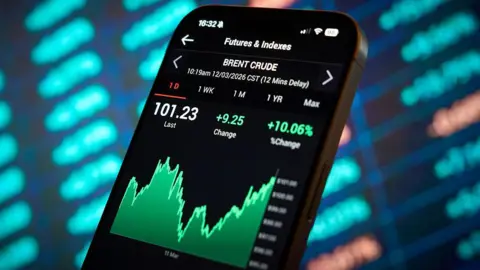
It can be difficult to pin down what is guiding Donald Trump one month after the American and Israeli programme of strikes on Iran.
However, it remains clear he has an eye on the global crude markets.
A word – or tweet – from the US president regarding his intentions used to trigger significant swings in oil prices, as traders reacted to indications the tensions could escalate or conclude.
However, in recent days, market players seem to be becoming increasingly doubtful about the impact of his comments.
The price of oil was trading at around $72 a barrel before 28 February, when the strikes on Iran began.
Last week, it climbed to $118 a barrel on 19 March and as of Friday afternoon was trading at around $112 – significantly higher than its pre-war price.
Below are some moments from the last month where Trump and the markets appear to have bounced off one another – with mixed impacts.
Navigate with the arrow to proceed to the next slide.
"Energy prices have become a proxy for wider geopolitical and economic uncertainties, jumping when Trump's language grows confrontational and falling back when his comments softens," says one financial expert.
He states that markets are appropriately attuned to those signals, given the big financial dangers that are associated with rising oil prices.
"Traders are trying to price genuine volatility," he says. "Markets can appear nervous or confused, but what they're actually doing is handling geopolitical risk in live, with oil acting as the core of that."
But, it can be difficult for traders to decide how to trade, given that a portion of Trump's statements seem intended to affecting oil prices, rather than articulating policy, says another market commentator.
"As they say, the initial victim of war is clarity," he remarks. "My belief is some of the communication trading of statements around productive talks, and the contrary, very much are focused on simply moving the price of oil."
Investor Response Grow More Tempered
On Thursday, moments after US stock markets recorded their largest decline since the start of the Iran war, Trump stated negotiations with Iran were going "extremely well" and he was delaying military strikes on Iran's oil facilities until at least 6 April.
Yet, the price of crude continued to increase.
One market analyst explains that investor responses are "growing increasingly subdued" because of the "wide divergence" between Trump's optimistic statements and the absence of acknowledgement from Tehran.
"Considering the current situation, many market watchers do not foresee an imminent resolution to the conflict and financial markets remain apprehensive."
Another investment director says markets have also become accustomed to Trump "repeatedly changing tack at signs of geopolitical, equity market or market turmoil".
"We are seeing a degree of doubt, or even downright suspicion, emerging at the fringes," he concludes.


